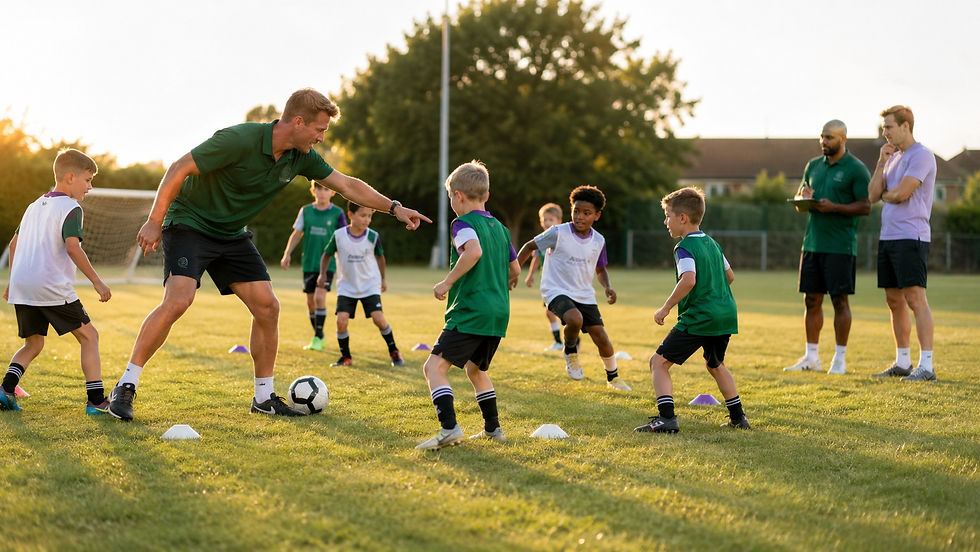
Academy Coach Evaluation | Beyond Results in Competitive Squads

Your child’s team is winning, but training feels rushed, feedback is vague and the same players carry most of the attention. Is the coach doing a good job?
In a competitive youth programme, league position is only one outcome. A stronger Academy Coach Evaluation looks across training quality, player development, workload decisions, behaviour, welfare and professional learning. The evidence supports those components more strongly than any single universal appraisal formula.
What Changes in Competitive Squads
Competitive squads increase the importance of how coaching decisions are planned, communicated and adjusted around individual players, not simply whether the team wins.
For this article, a competitive academy squad means a structured, selection-based youth programme with regular training and formal fixtures. Professional academies may also have sport science, medical, analysis and welfare staff. A grassroots competitive team may not.
More demanding programmes create greater responsibility around training load, physical development and injury management. Biological maturation is progress towards adult physical development, and players of the same age can be at very different stages.
What Academy Coach Evaluation Should Measure
Academy Coach Evaluation works best as a balanced review of coaching processes and player experience rather than a verdict built from results alone.
A balanced scorecard is an appraisal framework combining a small number of measures across different parts of coaching. No strong evidence establishes one universal scorecard for youth football, so academies should avoid pretending one number proves coaching quality.
Useful review areas include:
clear weekly training aims and appropriate progression
observation used for coach learning as well as judgement
individual development priorities that are revisited and acted upon
player-reported coach behaviour collected consistently
clear, respectful feedback after difficult results
A league table tells you what the team achieved. It does not tell you how well each young player was coached.
Why Load and Growth Belong in the Review
Competitive-squad coaches should be judged partly on whether they notice when planned work and player response begin to diverge.
Rating of perceived exertion, or RPE, is an athlete-reported measure of how hard a session felt. Coach estimates and athlete ratings are often only moderately to strongly aligned, with meaningful variation between settings.
A mismatch is not automatic proof of poor coaching. Repeated mismatches matter more if the coach never investigates or adjusts.
Evidence from high-level youth pathways also links growth and maturation with changing injury patterns, particularly around rapid growth periods. The practical standard is not to prevent every injury. It is to notice vulnerability and respond sensibly.
How Injury Prevention and Collaboration Fit In
Coach appraisal should examine whether injury-prevention work and multidisciplinary decisions are delivered consistently, especially in higher-resource academy environments.
Injury-prevention programmes can reduce injury risk in youth football when they are delivered consistently. Maturity-informed approaches can support injury-risk discussions, although the evidence does not justify using maturity data as a simple selection tool.
Where specialist staff exist, evaluation can examine whether the coach:
responds appropriately to medical and physical-performance advice
avoids pressuring players to train through unresolved injury concerns
communicates consistently with strength and conditioning, analysis and welfare staff
refers safeguarding, physical or psychological concerns through the correct route
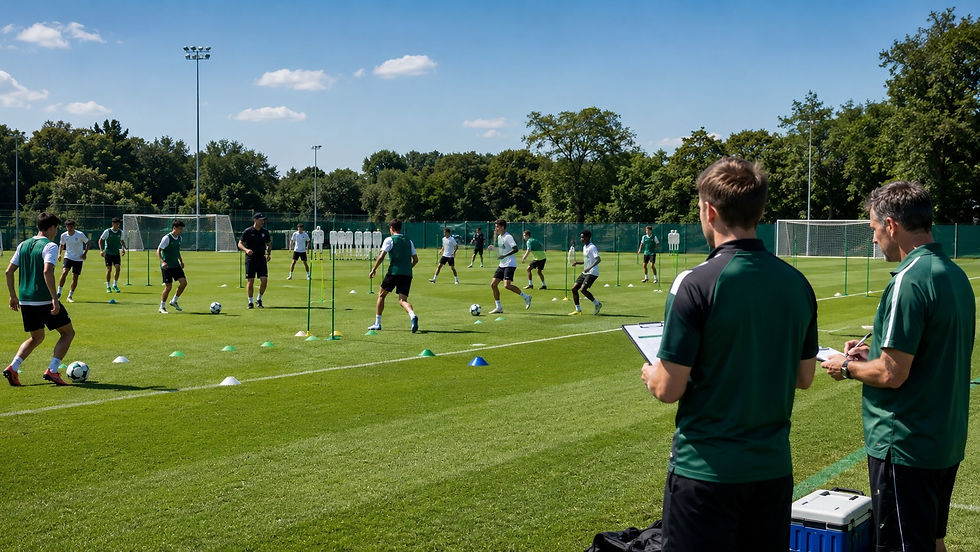
Why Behaviour and Coach Learning Still Matter
Competitive standards do not remove the need to evaluate coach behaviour, reflection and continued professional development.
Validated athlete-report tools can capture patterns in coach behaviour over time, and coaching behaviour can vary within the same coach across situations. One touchline incident is therefore a poor complete assessment, but repeated patterns deserve attention.
Coach education also matters. Recent synthesis across youth sport suggests education programmes can improve coaching effectiveness, although effects vary by programme design, context and transfer into everyday coaching.
Winning can sit inside a good programme. Winning cannot prove that the programme is good.
What Realistic Evaluation Looks Like
Realistic coach evaluation uses fewer meaningful measures repeatedly rather than creating large amounts of paperwork that nobody uses.
A practical academy review can set minimum standards for safety, conduct and professional responsibilities, then select one to three development targets for the next review block. Evidence can come from observation, player feedback, development records and workload discussions.
Parents do not need confidential staff appraisal details. They can reasonably ask how the academy defines coaching quality, how player feedback reaches decision-makers and what happens when welfare or safety concerns are raised.
Parent Questions
1. Should a competitive academy judge a coach by results?
A competitive academy should not judge a coach by results alone. League position shows what the team achieved, but not whether training was well designed, players received useful feedback or workload decisions were appropriate. A fairer appraisal combines performance outcomes with coaching behaviour, development processes, welfare standards and evidence of continued learning.
2. How can I tell whether my child’s coach is being properly evaluated?
Parents can look for signs that the academy uses more than one source of information about coaching quality. Useful signals include structured observation, player feedback, development reviews and clear routes for welfare concerns. You do not need confidential appraisal documents, but the academy should be able to explain how coaching standards are monitored and improved.
3. What should I do if my child says training feels too hard during a growth spurt?
A growth spurt should make workload concerns worth raising, not diagnosing at home. Rapid growth and maturation can coincide with changing injury patterns in high-level youth football, so persistent pain, unusual fatigue or repeated physical problems deserve qualified assessment. Ask how the academy is adjusting training and use its medical or welfare route when symptoms or safety concerns continue.
References
Castillo, D., Marqués-Jiménez, D., Bertollo, M., López-Flores, M., Bovolon, L., De Fano, A., & Pompa, D. (2025). A systematic review and meta-analysis of various injury prevention programs in youth soccer players. BMC Sports Science, Medicine and Rehabilitation, 17, 190. https://doi.org/10.1186/s13102-025-01246-8
Cope, E., Cushion, C. J., Harvey, S., & Partington, M. (2022). Re-visiting systematic observation: A pedagogical tool to support coach learning and development. Frontiers in Sports and Active Living, 4, 962690. https://doi.org/10.3389/fspor.2022.962690
Li, L., Olson, H. O., Tereschenko, I., Wang, A., & McCleery, J. (2025). Impact of coach education on coaching effectiveness in youth sport: A systematic review and meta-analysis. International Journal of Sports Science & Coaching, 20(1), 340–356. https://doi.org/10.1177/17479541241283442
Parry, G. N., Williams, S., McKay, C. D., Johnson, D. J., Bergeron, M. F., & Cumming, S. P. (2024). Associations between growth, maturation and injury in youth athletes engaged in elite pathways: A scoping review. British Journal of Sports Medicine, 58(17), 1001–1010. https://doi.org/10.1136/bjsports-2024-108233
Paul, D., Read, P., Farooq, A., & Jones, L. (2021). Factors influencing the association between coach and athlete rating of exertion: A systematic review and meta-analysis. Sports Medicine - Open, 7, 1. https://doi.org/10.1186/s40798-020-00287-2
Sullivan, J., Roberts, S., Enright, K., Littlewood, M., Johnson, D., & Hartley, D. (2024). Consensus on maturity-related injury risks and prevention in youth soccer: A Delphi study. PLOS ONE, 19(11), e0312568. https://doi.org/10.1371/journal.pone.0312568
Van Meervelt, K., Reynders, B., Van Puyenbroeck, S., De Backer, M., Hofmans, J., & Vande Broek, G. (2024). Validation of the Coach Behavior in Sports Questionnaire: Towards dynamic assessments using the circumplex model for coach behavior. Psychology of Sport and Exercise, 74, 102691. https://doi.org/10.1016/j.psychsport.2024.102691
Wik, E. H. (2022). Growth, maturation and injuries in high-level youth football (soccer): A mini review. Frontiers in Sports and Active Living, 4, 975900. https://doi.org/10.3389/fspor.2022.975900