Coach Time Pressure | When Part-Time Coaching Gets Rushed

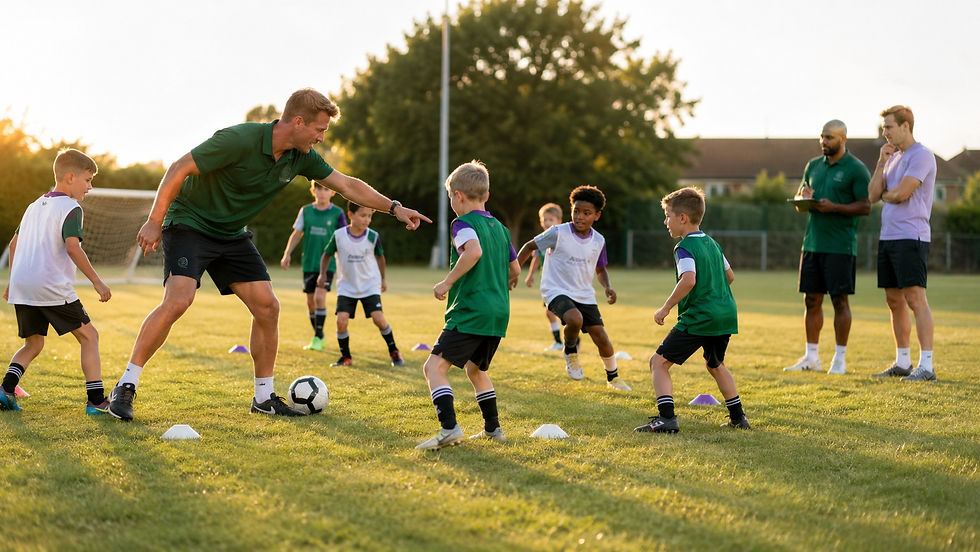
Tuesday night, the coach arrives from work with five minutes to spare, cones under one arm and messages still landing in the team WhatsApp. That does not make them a poor coach. The real issue is whether the club gives them enough protected time to plan, set up, communicate and supervise properly. Part-time coaching can work well. Rushed coaching systems are the bigger risk.
Why Coach Time Pressure Matters Before Training Starts
Coach Time Pressure matters because good youth coaching depends on preparation before the first player steps onto the pitch.
No evidence in the selected 2020+ evidence base establishes that part-time employment itself causes poorer coaching. The stronger evidence concerns what coaches need around them: education, time to apply learning, supportive behaviours and workable club systems. Coach education can improve coaching effectiveness, while interpersonal development programmes can improve some youth athlete outcomes.
The better parent question is not, “Does the coach have another job?” It is, “What does the club protect so the coach can do this job properly?”
Rushed Session Starts Can Reduce Structure
Rushed session starts can weaken structure because set-up, player contact and safety checks all compete for the same few minutes.
Preparation creates room to adapt for player numbers, pitch space, weather, ability differences or a player arriving with a restriction. Parents can notice whether:
equipment is ready,
the group knows where to start,
coaches are available rather than still sorting basic logistics,
the session progresses rather than repeatedly resetting.
One untidy evening proves very little. A repeated pattern is more useful.

Fatigue Can Affect the Quality of Attention
Coach fatigue can affect concentration and motivation, but the evidence does not justify assuming that a tired coach will shout or coach badly.
Club-coach evidence links fatigue with concentration and motivation measures. Broader evidence also associates autonomy-supportive coaching with better athlete wellbeing and lower distress.
Autonomy-supportive coaching is an interpersonal approach that gives players useful choice, clear reasons and respectful involvement without removing structure.
Parents should look for repeated signs of rushed attention, such as unclear instructions, inconsistent feedback or constant interruption, rather than judging the coach simply because they came straight from work.
Safety Needs Consistent Routines
Player safety depends on consistent routines, and time restrictions are a documented barrier to delivering injury-prevention warm-ups in youth team sport.
Neuromuscular training is a structured warm-up approach combining balance, strength, agility and movement-control exercises to reduce injury risk. Implementation evidence identifies time restrictions, limited buy-in and lack of support as barriers to consistent delivery.
Training load is the amount and intensity of football work a player is exposed to over time. Evidence linking training load with injury in elite youth football remains mixed, so simple workload formulas should not be treated as injury predictions.
If a young player is returning after injury, persistent pain, repeated injury or uncertainty should involve a qualified clinician.
Communication and Safeguarding Need Organisational Time
Communication and safeguarding are organisational responsibilities, so clubs should not leave them to one coach squeezing everything around another job.
Safeguarding is the system of policies, behaviours and responsibilities used to prevent and respond to harm in sport. Current consensus supports a whole-system approach rather than relying on one adult’s vigilance.
In a professional academy, planning, medical communication and safeguarding may be distributed across several staff. In a grassroots club or development programme, the system may be simpler, but the responsibilities remain.
Parents should expect clarity about:
who is present at arrival and collection,
who handles welfare or safeguarding concerns,
who communicates training and fixture changes,
who receives return-to-training information.
What a Strong Part-Time Coaching System Looks Like
A well-run part-time coaching system protects preparation time instead of expecting goodwill to cover planning, welfare and admin.
Clubs can support coaches with shared session frameworks, accessible warm-up resources, clear communication responsibilities and named safeguarding cover. Coach education is more useful when there is enough organisational support to apply it.
Part-time is an employment arrangement. Rushed is a delivery problem.
For parents, the useful evidence is the weekly pattern: prepared sessions, calm starts, clear communication, consistent safety routines and a club structure that does not make one coach carry everything alone.
Parent Questions
1.Should I worry if my child’s coach works another job?
Having another job does not make a youth football coach unsuitable or lower quality. The concern is whether the club provides enough preparation, communication and safeguarding cover around that coach. Look for repeated patterns across several weeks, including organised starts, clear messages and consistent routines, rather than judging one rushed evening.
2.What signs show a part-time coach has enough preparation time?
A part-time coach probably has workable preparation time when sessions start calmly, equipment is ready, activities have a clear purpose and communication is not constantly last-minute. No single sign proves good coaching, but repeated organisation matters. Parents can ask who plans sessions and how preparation is protected before training.
3.What should I ask if my child is returning from injury?
Parents should ask who receives the return-to-training information and how the session will be adapted within the guidance already provided. The coach should not be expected to diagnose an injury or make medical decisions. Persistent pain, repeated injury or uncertainty about safe participation should be referred to a qualified clinician.
References
Bengtsson, D., Stenling, A., Nygren, J., Ntoumanis, N., & Ivarsson, A. (2024). The effects of interpersonal development programmes with sport coaches and parents on youth athlete outcomes: A systematic review and meta-analysis. Psychology of Sport and Exercise, 70, 102558. https://doi.org/10.1016/j.psychsport.2023.102558
Li, L., Olson, H. O., Tereschenko, I., Wang, A., & McCleery, J. (2025). Impact of coach education on coaching effectiveness in youth sport: A systematic review and meta-analysis. International Journal of Sports Science & Coaching, 20(1), 340–356. https://doi.org/10.1177/17479541241283442
Lutz, D., van den Berg, C., Räisänen, A. M., Shill, I. J., Kim, J., Vaandering, K., Hayden, A., Pasanen, K., Schneider, K. J., Emery, C. A., & Owoeye, O. B. A. (2024). Best practices for the dissemination and implementation of neuromuscular training injury prevention warm-ups in youth team sport: A systematic review. British Journal of Sports Medicine, 58(11), 615–625. https://doi.org/10.1136/bjsports-2023-106906
Martínez-Moreno, A., Cavas-García, F., López-Gullón, J. M., & Díaz-Suárez, A. (2021). Effects of fatigue and grit on club sports coaches. International Journal of Environmental Research and Public Health, 18(14), 7414. https://doi.org/10.3390/ijerph18147414
Mossman, L. H., Slemp, G. R., Lewis, K. J., Colla, R. H., & O’Halloran, P. (2024). Autonomy support in sport and exercise settings: A systematic review and meta-analysis. International Review of Sport and Exercise Psychology, 17(1), 540–563. https://doi.org/10.1080/1750984X.2022.2031252
Nilsson, T., Börjesson, M., Lundblad, M., Ivarsson, A., & Fransson, D. (2023). Injury incidence in male elite youth football players is associated with preceding levels and changes in training load. BMJ Open Sport & Exercise Medicine, 9(4), e001638. https://doi.org/10.1136/bmjsem-2023-001638
Tuakli-Wosornu, Y. A., Burrows, K., Fasting, K., Hartill, M., Hodge, K., Kaufman, K., Kavanagh, E., Kirby, S. L., MacLeod, J. G., Mountjoy, M., Parent, S., Tak, M., Vertommen, T., & Rhind, D. J. A. (2024). IOC consensus statement: Interpersonal violence and safeguarding in sport. British Journal of Sports Medicine, 58(22), 1322–1344. https://doi.org/10.1136/bjsports-2024-108766
Verstappen, S., van Rijn, R. M., Cost, R., & Stubbe, J. H. (2021). The association between training load and injury risk in elite youth soccer players: A systematic review and best evidence synthesis. Sports Medicine - Open, 7, 6. https://doi.org/10.1186/s40798-020-00296-1