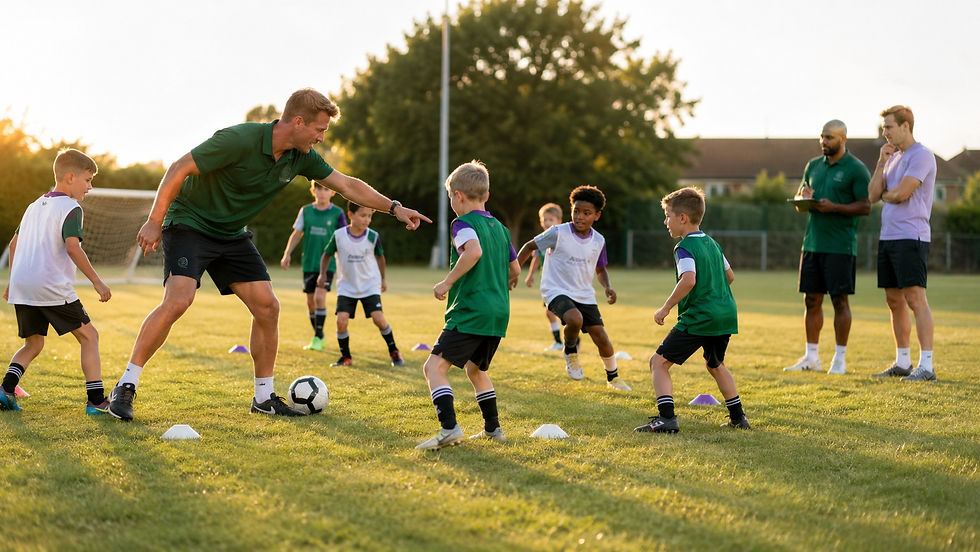
Football Academy Functions Parents Can Trust

A good academy is more than training sessions and weekend matches. For most families, it is a long relationship that shapes habits, confidence, and health. When you understand the Football Academy Functions that matter, you can judge whether your child is in the right place, ask better questions, and support progress without adding pressure.
Do you know what a good academy should really provide?
Football Academy Functions Parents Should Expect
The most important Football Academy Functions sit under one simple goal: helping each football player develop safely and steadily.
A well-run academy should be able to explain, in plain language:
What is taught at each age, and why.
How safety is managed, including injuries and concerns.
How confidence and enjoyment are protected, especially after mistakes.
How communication works with parents, school, and the wider week.
If answers are vague, change every week, or always come back to winning, treat that as a warning sign.
Coaching That Builds Skill And Decision-Making
Strong coaching is not just drills. It is a consistent learning system that matches the child’s stage.
Look for:
A clear playing idea, without locking children into one role too early.
Age-appropriate learning, where younger football players practise basics, scanning, and simple decisions, not adult tactics.
Individual feedback, including what is going well and one or two priorities to improve next.
Coach development, so staff keep learning and standards stay consistent across teams.
Pay attention to tone. The best environments demand effort while protecting dignity. Mistakes are treated as information, not embarrassment.

Growth-Aware Physical Development And Injury Prevention
In youth football, bodies change quickly. A good academy respects growth and maturation, not just calendar age.
Key functions include:
Smart training loads, enough to improve but not so much that constant fatigue becomes “normal”.
Repeatable warm-ups, taught properly and used often enough to become a habit.
Strength and movement basics, such as landing, balance, sprint mechanics, and safe change of direction.
A clear return-to-training pathway after injury, rather than “play through pain”.
Parent check: take repeated pain seriously. If pain lasts more than a few days, keeps returning, or changes how your child runs, ask for a written plan and, when needed, medical assessment.
Wellbeing, Safeguarding, And Culture
A modern academy must treat wellbeing and safeguarding as core work, not admin.
You should be able to see:
A written safeguarding policy and a clear reporting route.
Clear rules for transport, changing areas, and one-to-one contact.
Coaches who avoid shaming, threats, or fear-based motivation.
Support routes for mental wellbeing, including who to speak to if a football player feels overwhelmed.
No academy removes every risk. But it should reduce risks, respond quickly, and put the child before the result.
Matches, Reviews, And Next Steps
Matches are part of learning, not a final exam.
Better academies:
Use match minutes as a development tool, not only a reward for early developers.
Set simple match goals (for example, scanning before receiving, pressing triggers, or bravery in possession).
Hold regular reviews that consider football, school load, sleep, and home pressures.
Offer realistic options: stay, move group, play more locally, or balance football with another sport.
The best sign is honesty and clarity. A good academy can say, “Here is what we do well, here is what we are improving, and here is what your football player needs next.”
Parent Advice
Ask for one clear development priority for the next 6 to 8 weeks, and what “better” will look like.
Track sleep, mood, and lingering pain. Share patterns early, before problems grow.
Judge culture as much as coaching. Your child should feel safe, respected, and motivated.
Key Takeaways
Football Academy Functions should balance skill, safety, and wellbeing.
Good academies manage growth and training load, not just results.
Clear communication and safeguarding are non-negotiable.
Is your child’s academy doing more than just filling the week?
References
Bengtsson, D., Stenling, A., Nygren, J., Ntoumanis, N., & Ivarsson, A. (2024). The effects of interpersonal development programmes with sport coaches and parents on youth athlete outcomes: A systematic review and meta-analysis. Psychology of Sport and Exercise, 70, 102558. https://doi.org/10.1016/j.psychsport.2023.102558
Hong, H. J., Morris, R., López-Flores, M., & Botwina, G. (2022). An international analysis of dual careers support services for junior athletes in Europe. International Journal of Sport Policy and Politics, 14(2), 305–319. https://doi.org/10.1080/19406940.2021.1999301
Ramos, A. P., de Mesquita, R. S., Migliorini, F., Maffulli, N., & Okubo, R. (2024). FIFA 11+ KIDS in the prevention of soccer injuries in children: A systematic review. Journal of Orthopaedic Surgery and Research, 19, 413. https://doi.org/10.1186/s13018-024-04876-9
Robles-Palazón, F. J., López-Valenciano, A., De Ste Croix, M., Oliver, J. L., García-Gómez, A., Sainz de Baranda, P., & Ayala, F. (2022). Epidemiology of injuries in male and female youth football players: A systematic review and meta-analysis. Journal of Sport and Health Science, 11(6), 681–695. https://doi.org/10.1016/j.jshs.2021.10.002
Sothern, N. A., & O’Gorman, J. (2021). Exploring the mental health and wellbeing of professional academy footballers in England. Soccer & Society, 22(6), 641–654. https://doi.org/10.1080/14660970.2021.1952693
Towlson, C., Salter, J., Ade, J. D., Enright, K., Harper, L. D., Page, R. M., & Malone, J. J. (2021). Maturity-associated considerations for training load, injury risk, and physical performance in youth soccer: One size does not fit all. Journal of Sport and Health Science, 10(4), 403–412. https://doi.org/10.1016/j.jshs.2020.09.003
Tuakli-Wosornu, Y. A., Burrows, K., Fasting, K., Hartill, M., Hodge, K., Kaufman, K., Kavanagh, E., Kirby, S. L., MacLeod, J. G., Mountjoy, M., Parent, S., Tak, M., Vertommen, T., & Rhind, D. J. A. (2024). IOC consensus statement: interpersonal violence and safeguarding in sport. British Journal of Sports Medicine, 58(22), 1322–1344. https://doi.org/10.1136/bjsports-2024-108766