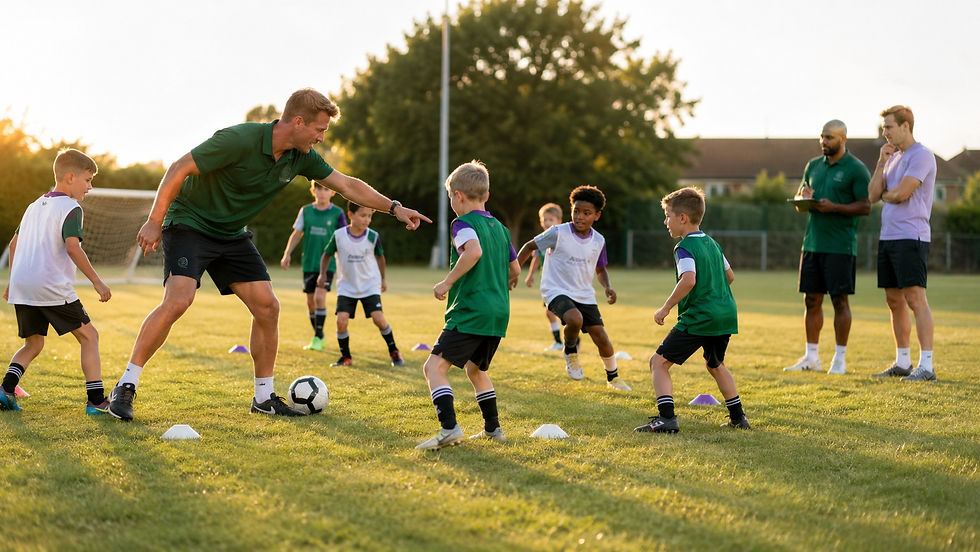
Full-Time Academy Coach | When More Hours Create Better Support

A full-time academy coach can make planning, feedback, safeguarding and workload coordination easier, but the employment contract itself does not prove coaching quality. For parents, the useful question is not simply whether the coach works full-time. It is what the extra hours are actually used for, and whether those hours create a more consistent, safer and more individual development environment for young players.
A Full-Time Academy Coach Can Create More Consistent Learning
A full-time academy coach may have more opportunity to connect sessions across the week and month instead of treating every training night as a separate event.
Good coaching depends on planning, observation, reflection and adjustment. Coach education programmes can improve coaching knowledge, behaviour and some athlete outcomes, although effects vary between programmes and settings.
Extra working hours can make those habits easier to sustain. A coach may have time to review the weekend, plan the next progression, speak with colleagues and adapt a session before the players arrive.
More coaching time creates capacity, not quality automatically.
More Time Can Mean Better Individual Feedback
A full-time academy coach can use time away from the pitch to make feedback clearer, shorter and more relevant to the individual player.
Autonomy-supportive coaching is a coaching approach that gives young players meaningful involvement, clear reasons and respectful guidance rather than relying mainly on control. Evidence across sport links this approach with stronger motivation and wellbeing, and lower distress.
Additional coach time may allow:
brief individual check-ins before or after training
simple development goals the player can remember
feedback that separates one mistake from the player’s overall ability
better communication when a role or expectation changes
None of those behaviours requires a full-time contract. A skilled part-time or volunteer coach can do them extremely well.

Training Load Needs Coordination, Not Guesswork
A full-time academy coach may be better placed to coordinate football exposure across training and matches, especially in demanding development or academy programmes.
Training load is the amount of physical work a player completes through training and competition, while school stress, sleep, growth and other sport can affect how well that work is tolerated.
Evidence in elite male youth football suggests injury incidence can be associated with preceding load patterns and changes. The evidence does not establish a simple causal formula that predicts which player will be injured.
More staff time can help an academy notice:
sudden changes in football exposure
repeated fatigue or niggles
return-to-training progress after injury
clashes between fixtures, school demands and recovery
Structured neuromuscular warm-ups can reduce injuries in youth team sport, but implementation and regular adherence matter. Full-time staffing may help consistency, but the programme still has to be delivered properly.
Safeguarding Depends on the Whole Environment
A full-time academy coach can strengthen daily safeguarding practice through greater presence, but safeguarding cannot rest on one coach being around more often.
Safeguarding is the system of behaviours, boundaries, reporting routes and organisational responsibilities used to reduce harm and respond appropriately when concerns arise.
Current evidence supports a whole-system approach. Good safeguarding depends on the culture and procedures around the coach as well as the behaviour of the individual coach.
Parents should expect clear arrangements around:
arrival and collection
adult-player boundaries
communication channels
supervision
reporting concerns
staff training and accountability
A coach being full-time may support those routines. A weak safeguarding system does not become strong because one member of staff has a bigger contract.
What Parents Should Ask About a Full-Time Academy Coach
Parents should judge a full-time academy coach by the systems and behaviours the extra hours make possible, not by the job title alone.
Useful questions are specific:
“How do you plan player development across several weeks?”
“How is individual feedback recorded or followed up?”
“How do you coordinate training load, matches and return from injury?”
“Who is responsible for safeguarding, and how are concerns reported?”
“What coach development or supervision happens during the season?”
In a professional academy, those questions may sit inside a larger multidisciplinary structure. In a grassroots club, employing a full-time coach may be unrealistic and unnecessary.
The standard should be appropriate organisation, qualified coaching and clear responsibility, not employment status for its own sake.
Parent Questions
1. Should I choose an academy because it has full-time coaches?
No, a full-time coach should be treated as one quality signal, not a guarantee of a better academy. The stronger signs are connected session planning, individual feedback, clear safeguarding procedures and sensible coordination of player workload. Ask how the coach’s non-contact hours are used and what parents should expect to see across a normal month.
2. What should a full-time academy coach be doing outside training?
A full-time coach should use non-contact hours for planning, reviewing players, coordinating with staff, following safeguarding procedures and preparing appropriate feedback. The exact balance will vary by age and academy structure. Parents do not need a minute-by-minute job description, but the club should be able to explain how those extra hours improve the player experience.
3. Can a part-time grassroots coach still provide high-quality coaching?
Yes, a part-time or volunteer grassroots coach can provide excellent coaching without holding a full-time role. Coaching quality depends on knowledge, behaviour, planning, relationships and the support provided by the club. Grassroots parents should judge whether sessions are purposeful, communication is clear and safeguarding responsibilities are understood rather than assuming professional employment automatically means professional-quality coaching.
References
Bengtsson, D., Stenling, A., Nygren, J., Ntoumanis, N., & Ivarsson, A. (2024). The effects of interpersonal development programmes with sport coaches and parents on youth athlete outcomes: A systematic review and meta-analysis. Psychology of Sport and Exercise, 70, 102558. https://doi.org/10.1016/j.psychsport.2023.102558
Li, L., Olson, H. O., Tereschenko, I., Wang, A., & McCleery, J. (2025). Impact of coach education on coaching effectiveness in youth sport: A systematic review and meta-analysis. International Journal of Sports Science & Coaching, 20(1), 340-356. https://doi.org/10.1177/17479541241283442
Lutz, D., van den Berg, C., Räisänen, A. M., Shill, I. J., Kim, J., Vaandering, K., Hayden, A., Pasanen, K., Schneider, K. J., Emery, C. A., & Owoeye, O. B. A. (2024). Best practices for the dissemination and implementation of neuromuscular training injury prevention warm-ups in youth team sport: A systematic review. British Journal of Sports Medicine, 58(11), 615-625. https://doi.org/10.1136/bjsports-2023-106906
Mossman, L. H., Slemp, G. R., Lewis, K. J., Colla, R. H., & O’Halloran, P. (2022). Autonomy support in sport and exercise settings: A systematic review and meta-analysis. International Review of Sport and Exercise Psychology, 17(1), 540-563. https://doi.org/10.1080/1750984X.2022.2031252
Nilsson, T., Börjesson, M., Lundblad, M., Ivarsson, A., & Fransson, D. (2023). Injury incidence in male elite youth football players is associated with preceding levels and changes in training load. BMJ Open Sport & Exercise Medicine, 9(4), e001638. https://doi.org/10.1136/bmjsem-2023-001638
Obërtinca, R., Meha, R., Hoxha, I., Shabani, B., Meyer, T., & Aus der Fünten, K. (2024). Efficacy of a new injury prevention programme (FUNBALL) in young male football (soccer) players: A cluster-randomised controlled trial. British Journal of Sports Medicine, 58(10), 548-555. https://doi.org/10.1136/bjsports-2023-107388
Tuakli-Wosornu, Y. A., Burrows, K., Fasting, K., Hartill, M., Hodge, K., Kaufman, K., Kavanagh, E., Kirby, S. L., MacLeod, J. G., Mountjoy, M., Parent, S., Tak, M., Vertommen, T., & Rhind, D. J. A. (2024). IOC consensus statement: Interpersonal violence and safeguarding in sport. British Journal of Sports Medicine, 58(22), 1322-1344. https://doi.org/10.1136/bjsports-2024-108766