Calm Problem Solver | Steady Under Pressure
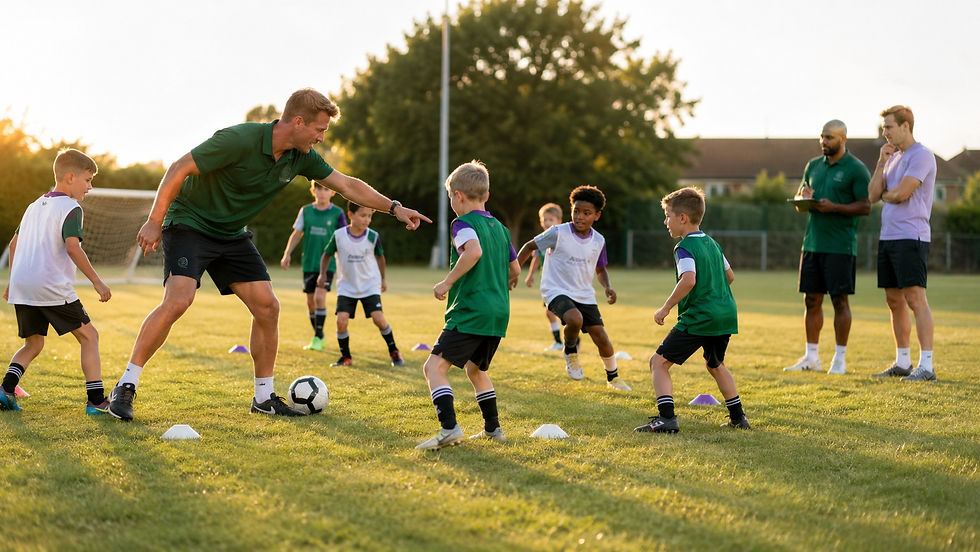
Some coaches stand out not when things go well, but when things go wrong. The calm problem solver stays steady through a bad touch, an early goal, or a drill that falls apart. Instead of visible anger, blame, or dramatic reactions, this coach fixes the problem. For many young football players, that steadiness is not just pleasant. It is what keeps them learning.
How does your child’s coach react when things go wrong?
Why This Coach Type Changes How Players Learn
Young football players learn faster when they can pay attention. Coach emotional contagion changes that equation. When a coach reacts with visible anger, sarcasm, or unpredictable mood swings, players do not simply notice it. They absorb it. Their attention shifts from the drill or the next decision towards self-protection: playing safe, hiding from the ball, or rushing just to avoid making an error.
A calm problem solver disrupts that pattern. By keeping the environment predictable, this coach removes what is known as unnecessary threat. The challenge stays. The fear of emotional fallout does not.
The Calm Problem Solver | In Training and on the Touchline
This coach's behaviour holds steady across contexts. On the training pitch and on the matchday touchline, the same pattern tends to appear:
The voice stays measured, even under pressure.
Corrections are short and specific: one cue, not a lecture.
Body language stays controlled. No public reaction after an error.
The coach resets quickly: "Next one. What do we change?"
In training, the calm problem solver often builds what are called reset routines: a short sequence of stop, breathe, and scan, before restarting with intention. In matches, the same approach applies. When a football player makes an error, the coach's attention goes to the next action, not the last mistake.

Feedback That Calms | Without Lowering the Standard
The calm problem solver can be genuinely demanding. The key difference is in the delivery. This coach:
Separates behaviour from identity: "That pass was rushed" rather than "You are lazy."
Gives one actionable cue: "Open your body earlier."
Avoids public humiliation after errors.
The reason this matters is that coach emotional contagion is real. A coach's visible affective state transfers to players, shaping how they feel and how well they process feedback. A calm and steady presence can interrupt anxiety spirals even when the team is struggling.
Calmness Is Not Avoidance
One common misunderstanding about the calm problem solver is that calm means passive. It does not. Genuine calm problem-solving still requires:
Clear boundaries around respect and safety.
Quick, direct intervention when behaviour crosses a line.
Consistent standards for effort and focus.
The healthiest version of this coach is warm, firm, and consistent. Football players know what is expected. They know what to do after an error. And they know that mistakes will be handled with clarity, not drama.
Parent Advice
If your child hides from the ball or rushes decisions, coach emotional contagion may be pulling them into self-protection mode.
If a coach labels your child "lazy" after errors, that is identity-based feedback. It raises anxiety instead of fixing the actual behaviour.
When the coach gives one cue after each error and resets, your child stays in learning mode rather than drifting into self-protection.
Key Takeaways
Coach emotional contagion transfers the coach's affective state directly to players, cutting attention, risk-taking, and the ability to process feedback under pressure.
A calm problem solver is still demanding. The difference is one actionable cue rather than identity-based labels or prolonged criticism after errors.
Psychological safety requires a predictable environment. When a coach's emotional responses are consistent, young players direct attention towards skill, not threat
Does calm leadership help your child feel safe under pressure?
References
Şenel, E., Jowett, S., Adiloğulları, İ., & Kerr-Cumbo, R. (2024). Investigating the impact of coach behaviours and coach-athlete relationships on psychological safety. International Journal of Sport and Exercise Psychology, 23, 1051–1065. https://doi.org/10.1080/1612197X.2024.2369717
Tuakli-Wosornu, Y. A., Burrows, K., Fasting, K., Hartill, M., Hodge, K., Kaufman, K., Kavanagh, E., Kirby, S. L., MacLeod, J. G., Mountjoy, M., Parent, S., Tak, M., Vertommen, T., & Rhind, D. J. A. (2024). IOC consensus statement: Interpersonal violence and safeguarding in sport. British Journal of Sports Medicine, 58(22), 1322–1344. https://doi.org/10.1136/bjsports-2024-108766
Vella, S. A., Mayland, E., Schweickle, M. J., Sutcliffe, J. T., McEwan, D., & Swann, C. (2022). Psychological safety in sport: A systematic review and concept analysis. International Review of Sport and Exercise Psychology. Advance online publication. https://doi.org/10.1080/1750984X.2022.2028306
Willson, E., Buono, S., Kerr, G., & Stirling, A. (2025). The relationship between psychological abuse, athlete satisfaction, eating disorder and self-harm indicators in elite athletes. Frontiers in Sports and Active Living, 6, 1406775. https://doi.org/10.3389/fspor.2024.1406775
Willson, E., Buono, S., Kerr, G., & Stirling, A. (2023). Maltreatment experiences and mental health indicators among elite athletes. Psychology of Sport and Exercise, 69, 102493. https://doi.org/10.1016/j.psychsport.2023.102493