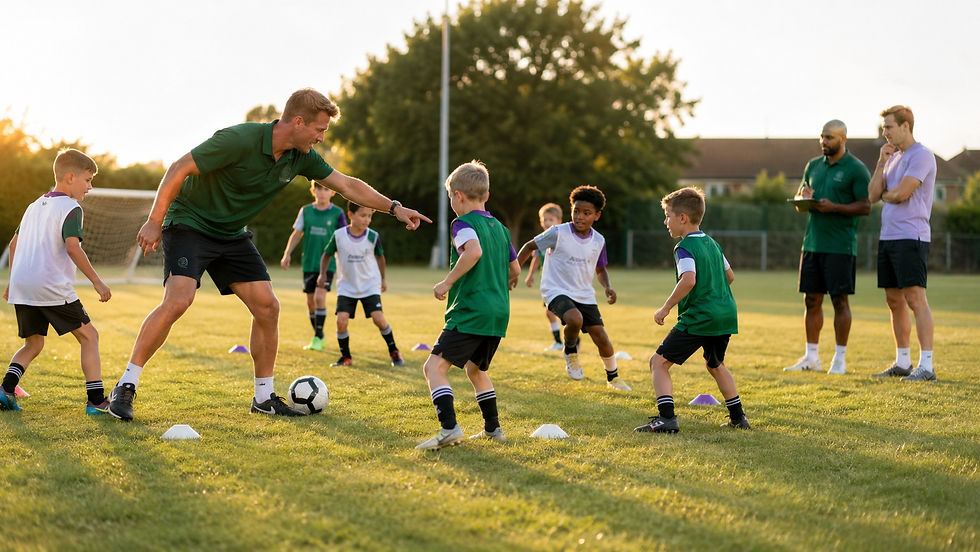
Favouritism Football Coach | How He Splits the Squad

A Favouritism Football Coach does not always mean a cruel coach. Often it begins as convenience. A few football players are easier to manage, more confident, or physically early-developing. The damage is the pattern, not the preference. When attention, patience, and opportunity flow consistently to a small group, the rest of the squad learns a painful lesson. Effort is no longer the route to progress. Proximity to the coach is.
Does your child get equal attention and opportunity?
How Favourites Quietly Get Created
Favouritism shows up through small daily choices that stack up across weeks:
The same football players receive most of the coaching detail and tactical correction.
Mistakes from core players are excused, while identical mistakes from others are punished.
Private jokes, warmth, and casual chat stay reserved for a small inner group.
Selection feels pre-decided, even inside small-sided games at training.
The coach may defend the pattern as merit. Real merit is possible. Favouritism is different because the criteria are unclear, shifting, and applied unevenly. The same action produces different consequences depending on who performed it.
What a Favouritism Football Coach Does to the Squad
A Favouritism Football Coach quietly creates two teams inside one team:
Insiders who feel protected, take more risks, and stay loud.
Outsiders who feel watched, become cautious, and go quiet.
That split damages squad cohesion in measurable ways. Football players stop helping each other because they are competing for the coach's attention rather than the team's result. Effort becomes strategic and selective. The unspoken question becomes, "Why run if it changes nothing?" The atmosphere flattens, sarcasm creeps in, and quiet resentment builds. Coach leadership behaviour is consistently linked to athlete satisfaction and cohesion, and when fairness disappears, both fall together.

The Quiet Warning Signs in Football Players
Favouritism rarely produces dramatic outbursts. It produces small withdrawals. Watch for these shifts:
Reduced communication between lines and during transitions.
More blame language after mistakes, both from the bench and on the pitch.
Football players avoiding eye contact with the coach during instructions.
A drop in second-effort actions like pressing the ball and tracking back.
The football players most affected are often not the least talented. They are the ones who need teaching time to close a gap, and that teaching time is exactly what a Favouritism Football Coach hands to the inner group instead.
What Fair Actually Means in Practice
Fair does not always mean equal minutes for every football player. It means three things that a parent can actually observe:
Consistent standards for effort, behaviour, and respect, applied identically across the squad.
Clear reasons for roles, positions, and selection, given in concrete and repeatable language.
Coaching attention and correction spread across the entire group, not concentrated on a chosen few.
When football players believe decisions are consistent, they invest. When they believe decisions are social, they protect themselves and the team's level slowly drops.
Parent Advice
Track whether identical mistakes by different football players in the squad meet identical coach responses, because that asymmetry is the clearest favouritism marker.
Ask your child if pressing, tracking back, and talking to teammates feel worth it lately, because dropping second-effort actions signals lost belief in fairness.
Listen for whether selection reasons sound concrete and repeatable, because vague language about roles often hides social criteria the squad cannot influence.
Key Takeaways
Favouritism damages a squad through status-based asymmetry, where the same action produces different consequences and outsiders quietly stop investing voluntary effort.
Watch second-effort behaviours like pressing and recovery runs, because their drop reveals lost belief in fairness long before any complaint reaches the parent.
Concrete and repeatable selection criteria let football players invest in performance, while vague reasons push them into protecting themselves from social decisions instead
Is effort truly rewarded in your child’s team?
References
Corbett, R., Partington, M., Ryan, L., & Cope, E. (2024). A systematic review of coach augmented verbal feedback during practice and competition in team sports. International Journal of Sports Science & Coaching, 19(2), 864-881. https://doi.org/10.1177/17479541231218665
Lemelin, E., Verner-Filion, J., Carpentier, J., Carbonneau, N., & Mageau, G. A. (2022). Autonomy support in sport contexts: The role of parents and coaches in the promotion of athlete well-being and performance. Sport, Exercise, and Performance Psychology, 11(3), 305-319. https://doi.org/10.1037/spy0000287
Li, L., Olson, H. O., Tereschenko, I., Wang, A., & McCleery, J. (2024). Impact of coach education on coaching effectiveness in youth sport: A systematic review and meta-analysis. International Journal of Sports Science & Coaching, 20(1), 340-356. https://doi.org/10.1177/17479541241283442
Lochbaum, M., & Sisneros, C. (2024). A systematic review with a meta-analysis of the motivational climate and hedonic well-being constructs: The importance of the athlete level. European Journal of Investigation in Health, Psychology and Education, 14(4), 976-1001. https://doi.org/10.3390/ejihpe14040064
Zhu, J., Wang, M., Cruz, A. B., & Kim, H.-D. (2024). Systematic review and meta-analysis of Chinese coach leadership and athlete satisfaction and cohesion. Frontiers in Psychology, 15, 1385178. https://doi.org/10.3389/fpsyg.2024.1385178