Player Development Coach | Build Skills Over Wins

Your child's coach makes hundreds of small decisions every session: what skill to introduce, how to respond to mistakes, and what success actually looks like. A player development coach makes every one of those decisions with the same priority, building skills that last rather than chasing results that fade. Knowing what that looks like in training changes how you read what you see on the sideline.
Is your child being coached for improvement, not just results?
The Climate a Player Development Coach Creates
The defining feature is the mastery motivational climate this coach builds. In this environment, effort, learning, and improvement carry more weight than results or comparisons with teammates. A mastery climate produces meaningfully higher enjoyment and satisfaction in youth athletes compared with environments that reward winning or ranking players against each other. Fear of failure drops because mistakes are treated as learning material, not as evidence of weakness.
You will hear language that reflects this:
"What did you notice there?"
"Try that again with one small adjustment."
"Better decision, keep that going."
This coach sets high standards for attitude and concentration. A low-fear environment is not a low-demand one. The difference is what mistakes cost: in a mastery climate, they cost nothing except the chance to learn from them.
How Sessions Are Organised
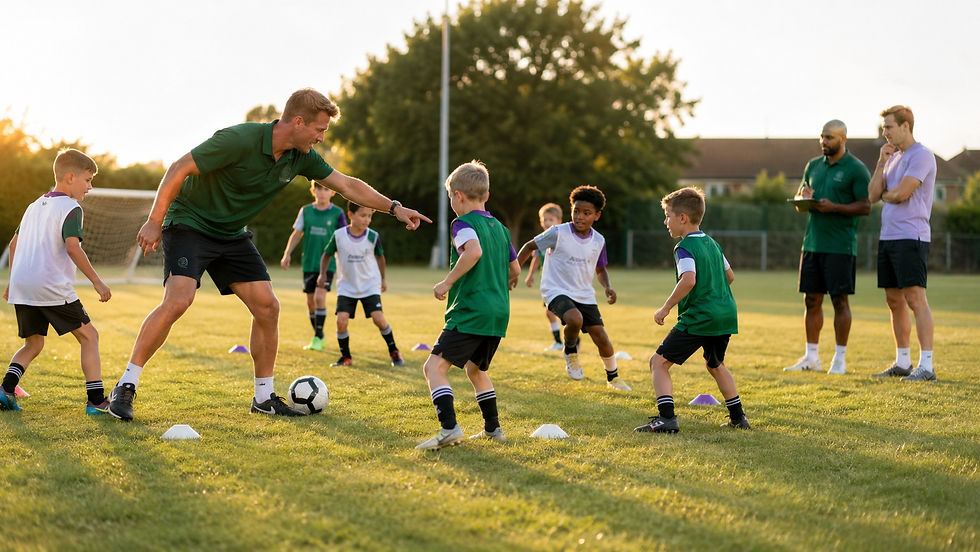
Training has a specific theme, such as first touch, scanning, or pressing angles. A player development coach builds sessions around:
Short teaching moments followed by extended play.
Small-sided games, fewer players on a smaller pitch, which increase each player's touches and decisions per session compared with full-sided training.
Task constraints: a rule, a spatial adjustment, or a scoring condition designed so that the right behaviours emerge naturally. When a coach says they are using constraints, they are reshaping the task structure rather than repeating verbal instructions.
The coach watches and adjusts. If the group struggles, the task gets simpler. If progress is clear, the difficulty rises. Blame does not enter the process. Adjustments come from the task, not from comments directed at the player who made the error.

Specific Feedback | The Signal That Matters Most
The clearest observable marker of a player development coach is specific process feedback: not "well done", but "great body position before receiving" or "you scanned early, so you spotted that pass". Feedback that names exactly what a player did or decided outperforms generic praise for learning in team sport training.
Feedback timing also matters:
Brief cues during play, so the session keeps its rhythm.
Longer explanations at natural breaks.
Questions that prompt thinking: "What did you see?" and "What would you do differently earlier?"
Private corrections protect confidence. If a player appears anxious, one quiet cue at a time is more effective than a public correction. One clear message at a time, no more.
Measuring Progress Without Scorelines
A player development coach accepts short-term messiness to build long-term skill. If your child attempts a coached behaviour in a match and loses the ball doing it, that is the process working, not failing.
Progress shows as small wins that accumulate:
Coached behaviours appearing in matches, not only in training.
Fewer repeat mistakes in identical situations.
Better team communication and positional awareness.
Players arriving keen and leaving tired but motivated to return.
Results feed into the same question: what does this result tell us about what to work on next? The answer shapes next week's theme.
Parent Advice
At your child's next session, listen for feedback that names a specific behaviour, such as scanning or body position, not just outcomes.
When your child mentions the coach asked "What did you see?", that question signals a mastery climate and deliberate skill building.
Short-term messiness after a new training theme is normal. It signals your child is attempting deeper skill changes, not regressing.
Key Takeaways
A mastery motivational climate, where effort and improvement matter most, produces meaningfully higher satisfaction in youth athletes than outcome-focused environments.
Specific process feedback, naming body position, scanning, or movement decisions, is the hallmark behaviour of a player development coach.
Small-sided games increase decisions per session and are the core tool a player development coach uses to build durable skill.
Is your child making better decisions and real progress?
References
Bengtsson, D., Stenling, A., Nygren, J., Ntoumanis, N., & Ivarsson, A. (2024). The effects of interpersonal development programmes with sport coaches and parents on youth athlete outcomes: A systematic review and meta-analysis. Psychology of Sport and Exercise, 70, 102558. https://doi.org/10.1016/j.psychsport.2023.102558
Clemente, F. M., Ramirez-Campillo, R., Sarmento, H., Praça, G. M., Afonso, J., Silva, A. F., Rosemann, T., & Knechtle, B. (2021). Effects of small-sided game interventions on the technical execution and tactical behaviors of young and youth team sports players: A systematic review and meta-analysis. Frontiers in Psychology, 12, 667041. https://doi.org/10.3389/fpsyg.2021.667041
Corbett, R., Partington, M., Ryan, L., & Cope, E. (2024). A systematic review of coach augmented verbal feedback during practice and competition in team sports. International Journal of Sports Science & Coaching, 19(2), 864–881. https://doi.org/10.1177/17479541231218665
Li, L., Olson, H. O., Tereschenko, I., Wang, A., & McCleery, J. (2024). Impact of coach education on coaching effectiveness in youth sport: A systematic review and meta-analysis. International Journal of Sports Science & Coaching, 20(1), 340–356. https://doi.org/10.1177/17479541241283442
Lochbaum, M., & Sisneros, C. (2024). A systematic review with a meta-analysis of the motivational climate and hedonic well-being constructs: The importance of the athlete level. European Journal of Investigation in Health, Psychology and Education, 14(4), 976–1001. https://doi.org/10.3390/ejihpe14040064