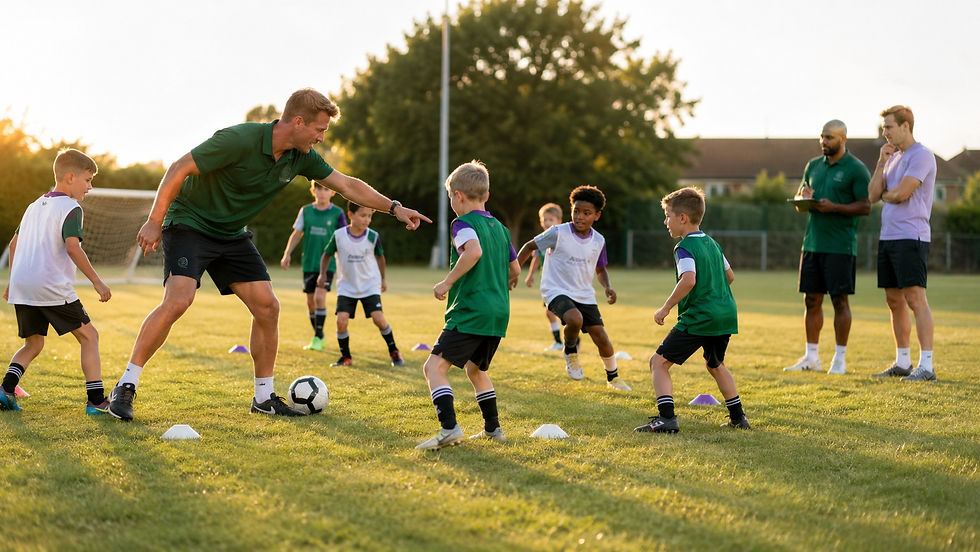
Autonomy Coach | Makes Players Think

A youth football player learns faster when they feel ownership, not pressure. That is the heart of an autonomy coach. This coach is not “easy”. Standards stay high. The difference is how the standards are delivered, with purpose, choice inside boundaries, and feedback that teaches thinking.
Does your child feel trusted and involved by their coach?
What An Autonomy Coach Does Differently
An autonomy-supportive session still has structure. It still has rules. It still has consequences. But the coach avoids control tactics that create compliance without understanding.
You will usually notice four habits:
A clear “why” for the task (so the football player knows the aim).
Limited choices inside the drill (so the football player owns the decision).
A calm tone (so learning does not feel like a threat).
Listening first, then deciding (player voice matters, but it is not a vote).
This combination tends to create “buy-in”. Football players work harder because the goal makes sense and they feel respected.
The Three Behaviours To Listen For Today
Use this quick checklist during one training session. You are not judging the coach’s personality. You are spotting specific behaviours.
Purpose statement: “We are working on scanning so you can play quicker.”
Bounded choice: “You can press here or cover the pass. Choose one and commit.”
Question before cue: “What did you see?” then one clear instruction.
If you hear all three at least a few times, you are likely seeing an autonomy-supportive approach in real time.

Why This Builds Better Decision-Making
When a coach asks before telling, the football player has to retrieve information, describe what they noticed, and connect it to an action. That is the start of game understanding.
A useful pattern is:
Question (what did you see).
Short reflection (name the option).
One cue (try this next time).
That final “one cue” matters. Too many instructions turns feedback into noise. One clear cue keeps the football player brave enough to try again.
When Autonomy Support Turns Into Vague Coaching
Autonomy support fails when it becomes inconsistent. Football players still need:
Clear rules.
Predictable consequences.
Immediate stopping of unsafe behaviour.
If the coach offers “choice” but the boundaries are unclear, some football players get anxious and others push limits. The best autonomy support coach is warm and firm at the same time.
How Parents Can Reinforce This Without Coaching From The Touchline
You can support the same mechanism at home, without adding pressure.
After training, try a repeatable script:
“What did you see in that moment?”
“What option was there earlier?”
“Next time, will you choose A or B?” (two realistic options only)
That is autonomy support in parent language: question first, bounded choice, then one cue.
Parent advice
Run the “Why, Choice, Question” checklist once this week: in one session, write down one example you hear of the coach giving a clear “why”, one bounded choice, and one question before a cue. If you cannot find any, that is a signal the environment may be more controlling than autonomy-supportive.
Copy the coach’s question-first sequence in the car: ask “What did you see?”, then “What option was available earlier?”, then give one cue for next time. Do not add a second cue. This mirrors the autonomy support mechanism instead of piling on instructions.
Protect your child from guilt language by switching to bounded choices: if your child repeats sarcasm or threats they heard, end the conversation with two concrete options for the next session (for example, “press early” or “cover the pass”). This replaces controlling pressure with autonomy-supportive decision ownership.
Key takeaways
An autonomy coach raises standards using a clear “why”, bounded choices, and a calm, non-controlling tone.
Question-first feedback followed by one cue builds game understanding more reliably than constant telling.
Autonomy support only works with clear rules and consistent boundaries, otherwise it turns into vague coaching.
Is this the environment your child needs to grow?
References
Bengtsson, D., Stenling, A., Nygren, J., Ntoumanis, N., & Ivarsson, A. (2024). The effects of interpersonal development programmes with sport coaches and parents on youth athlete outcomes: A systematic review and meta-analysis. Psychology of Sport and Exercise, 70, 102558. https://doi.org/10.1016/j.psychsport.2023.102558
Li, L., Olson, H. O., Tereschenko, I., Wang, A., & McCleery, J. (2024). Impact of coach education on coaching effectiveness in youth sport: A systematic review and meta-analysis. International Journal of Sports Science & Coaching, 20(1), 340–356. https://doi.org/10.1177/17479541241283442
Mossman, L. H., Slemp, G. R., Lewis, K. J., Colla, R. H., & O’Halloran, P. (2022). Autonomy support in sport and exercise settings: A systematic review and meta-analysis. International Review of Sport and Exercise Psychology. Advance online publication. https://doi.org/10.1080/1750984X.2022.2031252
Lochbaum, M., & Sisneros, C. (2024). A systematic review with a meta-analysis of the motivational climate and hedonic well-being constructs: The importance of the athlete level. European Journal of Investigation in Health, Psychology and Education, 14(4), 976–1001. https://doi.org/10.3390/ejihpe14040064