Shouting Coach | Why Your Child Stops Learning
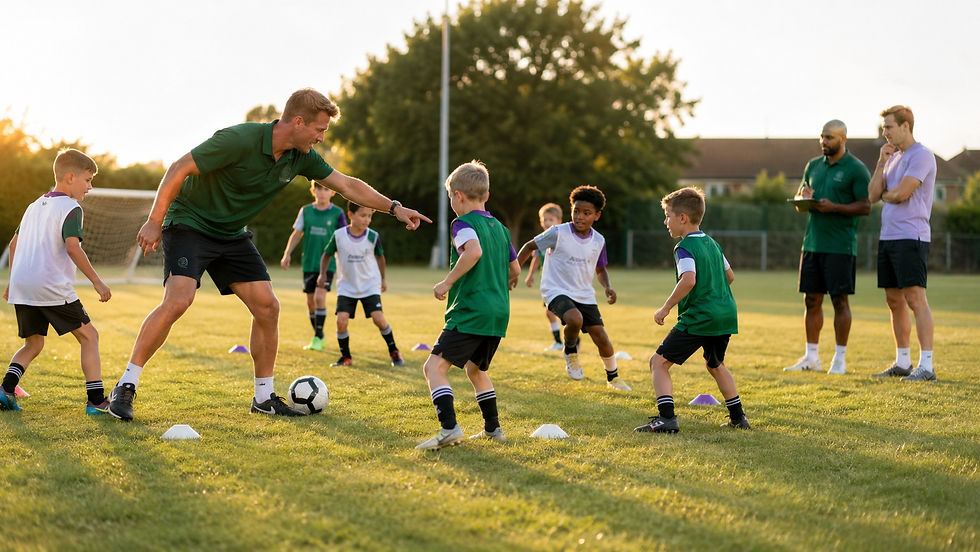
Your child's coach is often shouting. Not occasionally, not during a tight moment. Constantly. Instructions pile up. Mistakes get repeated in public. Negative feedback is the norm. You notice your child rushing passes, hiding on the pitch, shutting down after errors. This article explains the specific mechanism behind these changes, and gives you the exact step to take.
Does shouting dominate your child’s match experience?
The Disempowering Coaching Climate | What It Actually Means
There is a difference between a coach who raises their voice in a tense moment and one whose default tool is volume and public correction. When that correction is repeated, personal, and focused on highlighting failure, sport psychology calls it a disempowering coaching climate.
This is not a label for a demanding or emotionally intense coach. It describes a specific pattern:
constant instructions during play,
predominantly negative feedback,
public replaying of mistakes,
an ego-involving focus that compares players or targets individuals.
This pattern has measurable effects on how young football players think and move on the pitch.
How the Shouting Coach Impact Reaches Your Child's Brain
When a football player operates under a disempowering coaching climate, the brain shifts from learning mode to threat mode. The priority is no longer "what should I do next?" It becomes "how do I avoid the next criticism?"
This shows up in very specific ways:
Faster passing to release the ball rather than hold, scan, and decide
Positional hiding in areas with fewer touches and less visibility
Less creativity and skill-trying under pressure
Emotional collapse after a single mistake
A coach may interpret this as poor mentality. The accurate term is threat-response activation, a well-documented stress mechanism that replaces cognitive engagement with error-avoidance. The shouting coach impact works through one precise route: raising fear of failure, the variable directly linked to avoidance behaviour in youth sport.

Psychological Safety and Why This Climate Dismantles It
Psychological safety in sport describes an environment where athletes can ask questions, try unfamiliar skills, and make mistakes without fear of public humiliation. A high-volume, high-criticism culture actively dismantles this. It reduces a young football player's willingness to speak up, admit confusion, or experiment under pressure.
When Shouting Becomes a Safeguarding Concern
Occasional emotion from a coach is normal. A systematic pattern of yelling, belittling, sarcasm, and public humiliation is different. When this becomes personal and repetitive, it overlaps with psychological abuse in sport.
If the pattern at your child's club is severe or persistent, speak with the club welfare officer.
Parent Advice
When your child rushes passes or emotionally spirals after one mistake, name it as threat-response from a disempowering coaching climate.
Ask for a private meeting with the coach to address one specific pattern: the public replaying of your child's mistakes.
If your child's fear of failure is driving positional hiding, name autonomy-supportive coaching to the coach as the evidence-backed alternative.
Key Takeaways
A disempowering coaching climate raises fear of failure and burnout in youth athletes, not toughness, regardless of the coach's intent.
The rapid-pass and positional-hiding pattern you see on the pitch is threat-response behaviour, not a mentality problem with your child.
Repeated public criticism in youth football can cross into psychological abuse under International Olympic Committee safeguarding guidance when it becomes personal and systematic
Is your child still listening to learn, or just to avoid mistakes?
References
Birr, C., Hernandez-Mendo, A., Monteiro, D., & Rosado, A. (2023). Empowering and disempowering motivational coaching climate: A scoping review. Sustainability, 15(3), 2820. https://doi.org/10.3390/su15032820
Tuakli-Wosornu, Y. A., Burrows, K., Fasting, K., Hartill, M., Hodge, K., Kaufman, K., Kavanagh, E., Kirby, S. L., MacLeod, J. G., Mountjoy, M., Parent, S., Tak, M., Vertommen, T., & Rhind, D. J. A. (2024). IOC consensus statement: Interpersonal violence and safeguarding in sport. British Journal of Sports Medicine, 58(22), 1322–1344. https://doi.org/10.1136/bjsports-2024-108766
Vella, S. A., Mayland, E., Schweickle, M. J., Sutcliffe, J. T., McEwan, D., & Swann, C. (2022). Psychological safety in sport: A systematic review and concept analysis. International Review of Sport and Exercise Psychology. Advance online publication. https://doi.org/10.1080/1750984X.2022.2028306
Willson, E., Buono, S., Kerr, G., & Stirling, A. (2023). Maltreatment experiences and mental health indicators among elite athletes. Psychology of Sport and Exercise, 69, 102493. https://doi.org/10.1016/j.psychsport.2023.102493
Willson, E., Buono, S., Kerr, G., & Stirling, A. (2025). The relationship between psychological abuse, athlete satisfaction, eating disorder and self-harm indicators in elite athletes. Frontiers in Sports and Active Living, 6, 1406775. https://doi.org/10.3389/fspor.2024.1406775