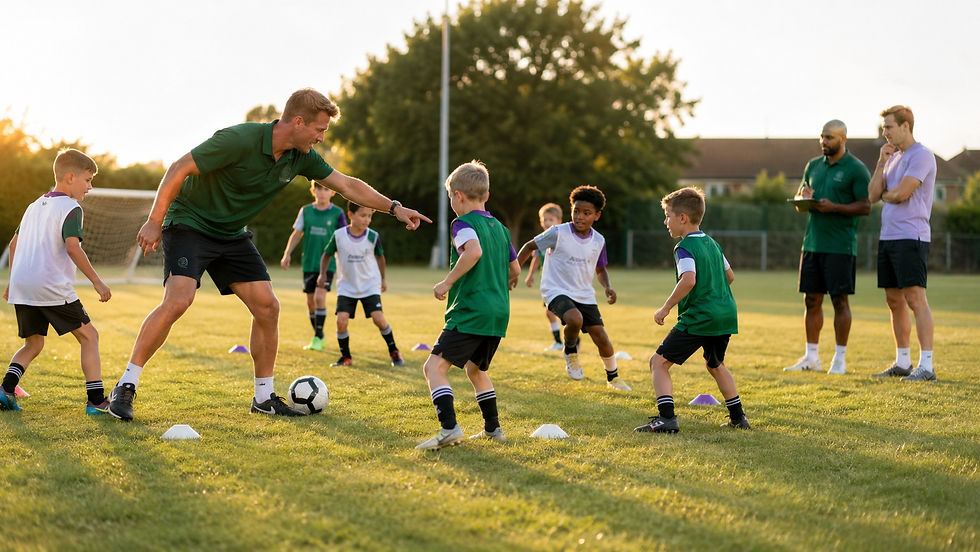
Controlling Youth Coach | Why Pressure Backfires

A controlling youth coach is often described as organised or no-nonsense. Training sessions can look strict and structured from the sideline. Football players may behave well in the moment, because the cost of getting something wrong feels high. But beneath the surface, something important is being lost. The coaching climate that appears disciplined is quietly replacing learning with compliance, and the effects accumulate across the season..
Does your child follow instructions but stop thinking for themselves?
What a Controlling Youth Coach Actually Does
A controlling youth coach relies on pressure to shape behaviour. The tactics can look like coaching, but they target emotions and identity rather than skill. Common signs include:
Constant micromanaging of movement and decisions
Threats about playing time, positions, or being dropped from the squad
Guilt aimed at the player's effort or commitment
Public comparison with teammates
Rules that shift depending on the coach's mood
This is not the same as structure. Structure means clear expectations, predictable consequences, and calm feedback. Control means pressure that puts a player's sense of belonging and identity at risk.

The Mechanism | Psychological Safety Disappears
Here is what happens inside a disempowering coaching climate. Football players learn quickly which behaviours attract criticism. They begin to check the coach before attempting anything new, a pattern called coach-checking behaviour and a visible sign that psychological safety has eroded. Instead of practising how to solve football problems, they practise how to avoid blame.
Psychological safety, the belief that attempting something risky will not cause harm, is essential for youth football development. Young players need to try a difficult turn, hold the ball under pressure, or attempt an unexpected pass. All of these involve risk of failure. When the environment makes failure feel dangerous, those attempts stop.
Short-Term Compliance vs Long-Term Learning
Pressure produces rapid behaviour change. This is why the controlling style persists: it works, visibly, from session to session. But youth football development depends on accumulated experimentation across weeks and months, not compliance in a single drill.
Longer-term patterns in a disempowering climate include:
Lower intrinsic motivation: football starts to feel like a test rather than a game
Higher anxiety around matches and selection decisions
Reduced creativity and slower game understanding
Reduced engagement when the coach is not watching, because the drive comes from outside rather than within
High Standards Without Control | A Better Model
High standards and autonomy support are not opposites. The most effective coaching environments keep clear expectations while changing the message:
"Here is the goal and why it matters."
"Here is what to try next."
"Mistakes are how we learn. Fix it and go again."
This approach protects psychological safety while preserving structure. In sport settings, autonomy-supportive coaching is consistently linked to better player well-being, stronger intrinsic motivation, and lower anxiety across age groups and competitive levels.
Parent Advice
Watch for coach-checking behaviour: your child glancing at the coach before each attempt. This signals a disempowering climate blocking their risk-taking.
If your child says football 'feels like a test,' a disempowering coaching climate is replacing intrinsic motivation with fear of blame.
Ask the coach how they handle mistakes in training. Coaches who use autonomy-supportive language treat errors as information, not evidence of disrespect.
Key Takeaways
A disempowering coaching climate reduces the experimentation youth football development depends on. Less trial and error means slower game understanding.
Psychological safety allows a football player to try risky moves and new skills. Controlling coaches remove it through threats and public comparison.
Quick compliance a controlling coach produces is real but temporary. Intrinsic motivation drains across the season without parents or coaches noticing.
Is compliance replacing learning in your child’s team?
References
Birr, C., Hernandez-Mendo, A., Monteiro, D., & Rosado, A. (2023). Empowering and disempowering motivational coaching climate: A scoping review. Sustainability, 15(3), 2820. https://doi.org/10.3390/su15032820
Gu, Y., & Cheng, L. (2025). A systematic review and meta-analysis of motivational climate and youth sport outcomes: Examining a hierarchical effects model. Frontiers in Psychology, 16, 1716745. https://doi.org/10.3389/fpsyg.2025.1716745
Manninen, M., Dishman, R., Hwang, Y., Magrum, E., Deng, Y., & Yli-Piipari, S. (2022). Self-determination theory based instructional interventions and motivational regulations in organized physical activity: A systematic review and multivariate meta-analysis. Psychology of Sport and Exercise, 61, 102248. https://doi.org/10.1016/j.psychsport.2022.102248
Mossman, L. H., Slemp, G. R., Lewis, K. J., Colla, R. H., & O’Halloran, P. (2022). Autonomy support in sport and exercise settings: A systematic review and meta-analysis. International Review of Sport and Exercise Psychology. Advance online publication. https://doi.org/10.1080/1750984X.2022.2031252
Vella, S. A., Mayland, E., Schweickle, M. J., Sutcliffe, J. T., McEwan, D., & Swann, C. (2022). Psychological safety in sport: A systematic review and concept analysis. International Review of Sport and Exercise Psychology. Advance online publication. https://doi.org/10.1080/1750984X.2022.2028306